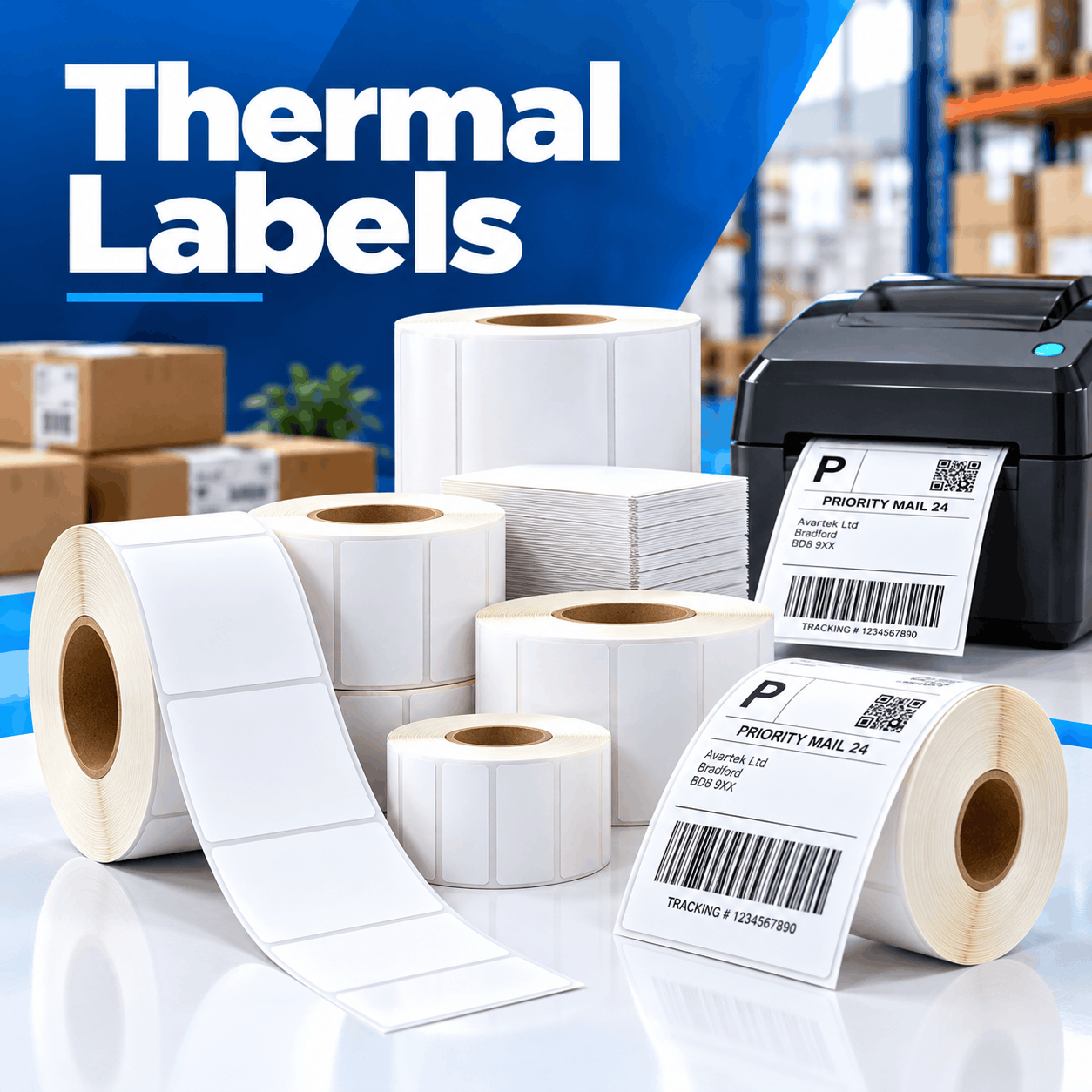
If your business prints labels every day, speed, reliability, and cost are important. A slow printing process and poorly sized labels will create delays with orders waiting to leave your warehouse. Direct thermal labels offer a straightforward solution for applications that need labels produced quickly without managing printer ribbons, ink, or toner.
Direct thermal labels are used for shipping, inventory control, barcodes and short-term product identification. Choosing the right labels, however, means looking at the dimensions printed on the box, as printer compatibility, adhesive strength, storage conditions and the expected life of the printed information all affect how well a label performs.
What Are Direct Thermal Labels?
Direct Thermal Labels are made from heat-sensitive material. When the label passes underneath the printer’s thermal printhead, carefully controlled heat causes areas of the coating to darken, forming the required text, barcode or image.
This means the printer does not need a separate ink cartridge, toner cartridge or thermal ribbon. Zebra describes direct thermal technology as printing directly onto heat-sensitive media, which is one of the main reasons it is commonly used for applications requiring straightforward, on-demand label production.
If your business processes a large number of parcels or you find you are regularly printing new stock labels, removing consumables from the process will make your day-to-day labelling easier. Staff load the appropriate roll or fanfold stack into a compatible printer and can start producing labels as required.
The important distinction is that these labels are designed primarily for information that does not need to remain readable indefinitely. Shipping labels are a good example because they only need to perform reliably throughout the fulfilment and delivery process.
Why Businesses Choose Direct Thermal Printing
One of the main reasons people choose direct thermal labels is how simple they are to use. There is no ribbon to install alongside the label roll, which means fewer supplies need to be ordered, stored and replaced.
Print speed is another advantage. Direct thermal printers are well suited to producing barcodes, addresses, tracking information, and other variable data as needed. Instead of preparing large batches in advance, you can generate a label for each parcel, item or location during the normal workflow.
The lack of ink and toner can also reduce maintenance and supply issues associated with conventional printing. That does not mean direct thermal printers require no maintenance, but they involve fewer printing consumables in normal operation.
When Direct Thermal Labels Are the Right Choice
The best label depends on what you need it for. Direct thermal labels are suitable when the printed information is needed for a relatively short period. Parcel delivery labels, courier labels, temporary stock identification and internal inventory labels are all common examples.
If a shipping label only needs to survive the journey from a warehouse to a customer’s address, direct thermal printing is often well suited to the task. If the same label must remain attached and legible on a product stored outdoors for several years, you may need another printing method.
Heat and prolonged exposure to strong sunlight are important things to think about because direct thermal material remains sensitive to its surroundings after printing. Zebra advises that direct thermal labels are less suitable for applications involving extended exposure to heat or direct sunlight.
Matching the label technology to the actual application prevents businesses from paying for durability they do not require while avoiding labels that are unsuitable for tougher conditions.
Direct Thermal Labels Versus Thermal Transfer Labels
Although the names sound similar, direct thermal and thermal transfer printing work differently.
Direct thermal printing applies heat directly to specially coated label material. Thermal transfer printing heats a ribbon, transferring the printed image from that ribbon onto the label. The main difference is durability.
Thermal transfer is generally the stronger choice for labels expected to remain readable for extended periods or face challenging environments. Direct thermal printing works particularly well for shorter-life applications where simplicity and fast printing are more important.
For dispatch labels, temporary warehouse identification, and many barcode applications, Direct Thermal Labels can provide the required performance without introducing a ribbon into the printing process.
Choosing the Correct Label Size
Choose label dimensions based on what needs to fit on the label, not simply the largest format the printer accepts.
Shipping labels, for example, normally need enough space for the delivery address, barcode, tracking reference and courier information to remain clear. Smaller inventory labels may only need a short product code and barcode.
When it comes to printer compatibility, take note that the label width, roll diameter and core size can all determine whether a particular roll will physically fit the printer. Fanfold labels introduce another option, feeding into compatible printers from a stack rather than a roll.
A 100 × 150 mm format is commonly used for shipping, while smaller sizes such as 58 × 40 mm can suit barcode, stock and product identification applications. Current ranges also include 100 × 50 mm and other dimensions for businesses with different labelling requirements.
Checking both the printer model and required label dimensions before ordering can prevent unnecessary returns and dispatch interruptions.
Getting Better Print Quality From Your Labels
A barcode label only works properly if the information is readable. If printed text appears pale, inconsistent or difficult to scan, replacing the labels immediately is not always the answer. Printer settings and the condition of the printhead should also be checked.
Using the correct print darkness and speed settings for the chosen direct thermal Labels can improve results. Printing too lightly may leave fine barcode lines poorly defined, while excessive heat can make printed areas heavier than required.
Make sure to keep the printhead clean, as dust, adhesive residue and debris can interfere with contact between the printhead and label surface. Before printing hundreds of labels, it is worth producing a small test batch and scanning several barcodes. A few seconds of testing can prevent an entire dispatch run having to be printed again.
Making Sure Labels Stay Attached
You want your shipping labels to stay attached for the duration of the parcels journey. The surface receiving the label should therefore be clean, dry and reasonably smooth before application.
Dusty cardboard, oily surfaces, or condensation can all make it harder for an adhesive to form a secure bond. Applying labels firmly across the whole surface rather than pressing only the centre can also help.
For most cardboard cartons, packaging and general warehouse applications, a permanent adhesive is normally appropriate. Several common Direct Thermal Labels are manufactured with permanent adhesive specifically for shipping, barcode and product labelling applications.
Storing Direct Thermal Labels Properly
How unused labels are stored can have a direct effect on future performance. Because direct thermal material reacts to heat, rolls should not be left beside radiators, heaters, sunny windows or other sources of high temperatures. Keep your stock away from direct sunlight.
A clean, dry storage area also helps protect the adhesive and label surface before printing. Labels left exposed in a dusty warehouse can collect contamination along their edges, while excessive moisture may affect both the label material and adhesive.
Stock rotation is another simple improvement. Rather than repeatedly using newly delivered boxes first, businesses can work through older stock before opening newer supplies.
The same care should continue after printing when information needs to remain readable for a reasonable period. Direct thermal material can gradually fade or darken following unsuitable exposure to heat, sunlight or chemicals, so important long-term identification may require a more durable alternative.
Direct Thermal Labels for Dispatch and Inventory
Dispatch is one area where Direct Thermal Labels make particular sense. Addresses and tracking information change for every order, so labels need to be generated quickly as each parcel moves through fulfilment. Standard shipping formats can provide enough space for barcodes and delivery information while allowing staff to peel and apply each label immediately.
For busier operations, fanfold thermal labels can also be worth considering. Rather than being wound around a roll, labels are supplied as a continuous folded stack. Some businesses prefer this arrangement for higher-volume printing because larger stacks can reduce how often media needs replacing.
Inventory applications can use smaller formats where appropriate. Barcodes, shelf locations, product references and temporary stock identification rarely require a full shipping-sized label, making compact Direct Thermal Labels a more economical option.
The most efficient approach is often to standardise a small number of label sizes around specific jobs. Doing so makes stock control easier and reduces the chance of the wrong media being loaded into a printer during a busy shift.
Order Direct Thermal Labels From Avartek
At Avartek, we supply Direct Thermal Labels in a range of sizes and formats for shipping, inventory, barcode and general product labelling.
We stock options compatible with widely used printers from brands including Zebra, Toshiba, Citizen and other direct thermal printer manufacturers, helping customers find labels that suit the equipment they already use.
Choosing suitable labels is about more than price. Size, printer compatibility, adhesive and the environment in which the label will be used all matter. Our range of thermal labels and rolls gives businesses practical options for everything from everyday dispatch to stock identification.
Explore our thermal label range to find the right size and format for your printer, or contact us if you need help narrowing down the available options.